This page explains (briefly) the theory of a rocket engine.
1. Introduction
2. Contraction ratio
3. Expansion ratio
4. Bell shape nozzle
5. Volume combustion chamber
6. Throat area
7. Sources
This page explains (briefly) the theory of a rocket engine.
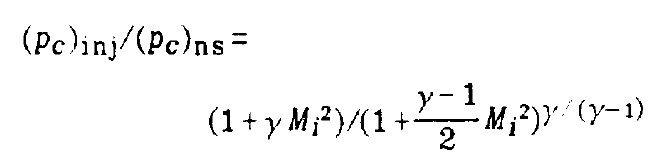 Equation for inlet pressure [1] |
In this equation the following parameters are defined:
- (Pc)_inj: Inlet pressure in bar
- (Pc)_ns: Chamber pressure in bar
- γ: Specific heat ratio
- Mi: Mach number of the inlet
The above equation also shows that a pressure loss occurs at the combustion chamber. The assumption is made that the gas velocity is zero at the injector. Heat will be released by the combustion process when the combustion gases flow from the injector towards the nozzle inlet. As a result, the specific volume will increase. This leads to the acceleration of the combustion gases to comply with constant mass flow. This acceleration results in a pressure drop. The total temperature will remain constant, but the total pressure will decrease, resulting in permanent losses. The decrease in pressure is a function of the gas properties, but also a function of the contraction ratio. The bigger the contraction ratio is, the smaller the losses are. [1]
The combustion area can be determined when knowing the temperature, pressure, specific volume, mass flow and velocity. [1]
In general, a larger engine has a smaller contraction ratio, while a smaller rocket engine has a larger contraction ratio. [1]
It is also possible to look at previous successful designs to determine the contraction ratio. A graph can be made using the different throat diameters and combustion chamber diameters. By using this graph, the contraction ratio of an engine can be determined. [1]
 Equation for the expansion ratio [2] |
In this equation the following parameters are defined:
- At: Throat area in m2
- Ax: Exit area in m2
- k: Specific heat ratio
- P1: Combustion chamber pressure in bar
- Px: Exit pressure in the nozzle in bar
As can be seen from this equation, the expansion ratio depends on gas properties (the specific heat ratio) and design parameters (Combustion pressure and exit pressure).
The value of the exit pressure can not freely be chosen. Based on the exit pressure, the nozzle can be over-expanded, ideal, or under-expanded:
Underexpanded is defined as when the pressure at the exit of the nozzle is higher than the ambient pressure. The negative effect of underexpanding is that potential thrust is wasted.
Overexpanded is defined as when the pressure at the exit of the nozzle is lower than the ambient pressure. The negative effect of overexpanding is that the lower pressure contributes to negative thrust.
Ideally expanded is defined when the pressure at the exit of the nozzle is equal to the ambient pressure. In general, the exit pressure is fixed (as the expansion ratio does not change), so the ambient pressure has to be fixed to have a nozzle that is ideally expanded. As a result, an ideally expanded nozzle is only possible for a fixed altitude. [1]
It is very challenging to optimize the expansion ratio for a booster engine, since the ambient pressure varies greatly. Potential performance would be lost when choosing an expansion ratio that is ideal at sea level. The reason for this is that the ambient pressure will decrease when the launch vehicle ascends and the nozzle is under-expanded. [1]
An over-expanded nozzle at sea level is often chosen for booster engines, since the performance would be better at higher altitudes compared to the ideally expanded nozzle for sea level. It is then accepted that the nozzle is over-expanded at sea level. [1]
1) cone-shaped
2) bell-shaped
The benefit of a cone-shaped nozzle is its simplicity. However, the nozzle length can be reduced by selecting the bell-shaped nozzle, thus saving weight and having a better performance. Nearly every launch vehicle uses a bell-shaped nozzle today. Therefore, the bell-shaped nozzle will be explained further.
The bell-shaped nozzle is described using a prescribed geometry, as can be seen in the figure below:
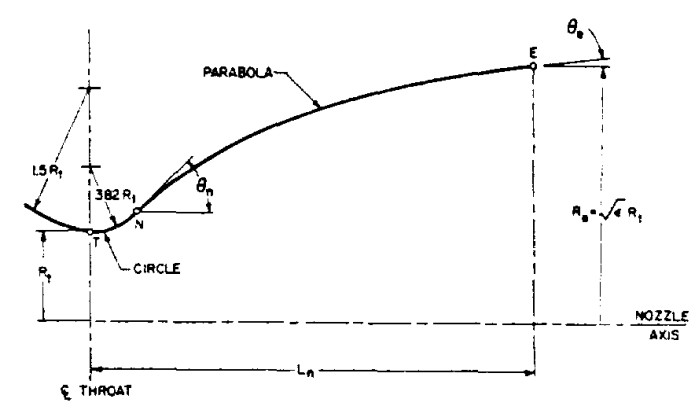 Prescribed gometry of a bell-shaped nozzle [1] |
As seen in Figure XX, the throat and the start of the bell-shaped are connected by a curve that has a constant radius of 0.385 times the radius of the throat. [1]
The inlet and the throat are also connected by a curve that has a constant radius, but this time it has a radius of 1.5 times the radius of the throat. [1]
The angle of the start of the bell-shaped nozzle is referred to as the initial parabolaangle, while the angle at the end of the bell-shaped nozzle is referred to as the final parabola angle. The value of these angles is a parameter of the used expansion ratio, but also the length of the bell-shaped nozzle. The length of the bell-shaped nozzle is often expressed as a percentage of the lenght of a cone angle that has a 15-degree half-angle. See figure below for a graph to determine the start and end angle of the bell- shaped nozzle: [1]
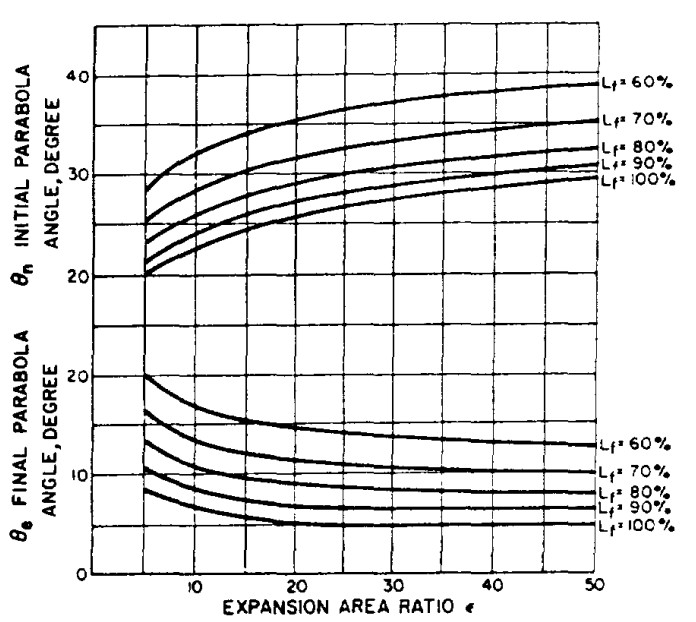 Values of the initial and final parabola angle [1] |
The parabola can be described by an equation. This equation has to fulfill the start and end points, but also the initial and final parabola angle. Therefore, the equation has four unknowns and is described as follows:
x=A* y^3+B* y^2 +C* y+D.
X is in the longitudinal direction, while y is the lateral direction. The parameters A, B, C and D are determined to fulfill the boundary conditions.
The time spent in the combustion chamber is referred to as stay time. The stay time depends on many parameters. To simplify the determination of the required combustion chamber volume, the parameter of characteristic length (L*) is defined. The characteristic length is defined according to figure XXX. The characteristic length is defined for a number of propellant combinations. [1]
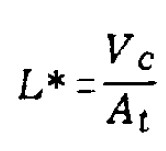 Definition characteristic length (L*) [1] |
In this equation the following parameters are defined:
- L*: characteristic length in m2
- Ax: throat area in m2
- Vc: Volume of the combustion chamber in m3
An increase in the characteristic length results in a larger and thus heavier combustion chamber. Secondly, an increase in L* leads to an increase in surface area that needs cooling and thus also an increase in thermal losses. Thirdly, an increase in L* results in an increase in frictional losses. [1]
At the throat, choked flow occurs, which is the condition where a maximum mass flow occurs for a nozzle. From this condition the throat area can be determined, as is defined by the following equation:
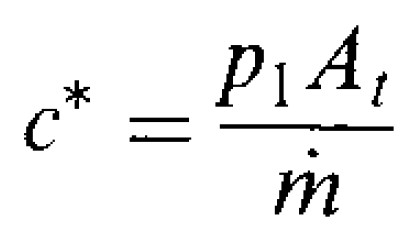 Definition throat area [2] |
In this equation the following parameters are defined:
- C*: characteristic velocity in m/s
- At: throat area in m2
- P1: chamber pressure in Pa
- m dot: mass flow in kg/s
As can be seen in the equation above, an increase in mass flow results in an increase in throat area. The throat area will decrease when the chamber pressure is increased.
[2]: Rocket Propulsion Elements - George P. Sutton and Oscar Biblarz