This page explains (briefly) the theory of the performance of a rocket engine.
1. Introduction
2. Characteristic velocity
3. Thrust coeficient
4. Thrust
5. Specific impulse
6. Sources
This page explains (briefly) the theory of the performance of a rocket engine.
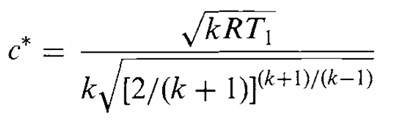 Equation for the characteristic velocity [2] |
In this equation the following parameters are defined:
- T1: Combustion temperature in Kelvin
- R: gas constant per unit weight, which is equal to the gas constant devided by the molar mass.
- k: Specific heat ratio
The characteristic velocity reaches a maximum before the maximum combustion temperature is reached when varying the oxidizer-to-fuel ratio of a given propellant combination. [1]
As a rule of thumb, the characteristic velocity has range between 1600 m/s (red fuming nitric acid and RP-1) and 2430 m/s (Oxygen and hydrogen). This is based on a chamber pressure of 1000 psi and ideally expaned with an exit pressure of 1 bar. [2]
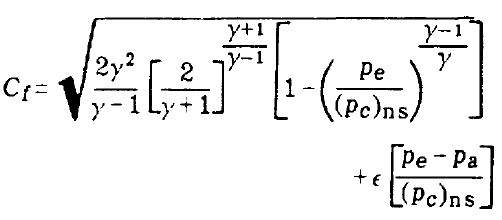 Definition of thrust coeficient [1] |
In this equation the following parameters are defined:
- Cf: Thrust coeficient [-]
- γ: Specific heat ratio [-]
- Pe: Exit pressure in Pa
- Pc ns: Chamber pressure Pa
- Pa: Ambiant pressure in Pa
- ε: Expansion ratio [-]
The thrust coeficient is also a function of the ambiant pressure, as can be seen in the above equation. The expansion ratio, which also influences the exit pressure of the nozzle, is a design parameter. Also the ratio of exit pressure over chamber pressure is a design parameter. The specific gas constant is a function of the choosen propellant combination. [1]
In general, the thrust coeficient has a value that is in a between 1.3 and 2.0. [1]
The thrust can be determined with the following equation:
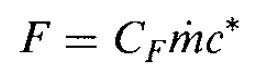 Definition of the thrust [1] |
In this equation the following parameters are defined:
- c*: characteristic velocity in m/s
- F: generated thrust in N
- m dot: mass flow in kg/s
- CF: Thrust coeficient
The specific impulse can be determined with the following equation:
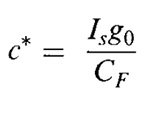 Definition isp [1] |
In this equation the following parameters are defined:
- c*: characteristic velocity in m/s
- Is: specific impulse in m/s
- g0: gravitiational acceleration in m/s2, which has a value of 9.81 m/s2
- CF: Thrust coeficient
As a general rule, the specific ipulse is in between 270 sec (red fuming nitric acid and RP-1) and 390 sec (Oxygen and hydrogen). This is based on a chamber pressure of 1000 psi and ideally expaned with an exit pressure of 1 bar. [2]
[2]: Rocket Propulsion Elements - George P. Sutton and Oscar Biblarz