This page explains (briefly) the theory of a turbopump for a rocket engine.
1. Introduction
2. Type of pumps
3. Type of turbine
4. Turbine power cycle
5. Turbine drives
6. Parameters Pump performance
7. Sources
This page explains (briefly) the theory of a turbopump for a rocket engine.
1) Centrifugal pumps
In general, the centrifugal pump is used in a turbopump assembly. This type is able to achieve high pressure and high flow rates in an efficient way. The centrifugal pump exists about 2 ellements: the rotor and stator. The Rotor accelerates the fluid and adds kinetic energy. The stator slows down the fluid, resulting in an increase in pressure. The rotor consists of an impeller, bearing and shaft. The stator consists of a casing with stationary vanes, a volute with discharge ducts and seals. An inducer can be added to increase the pressure to prevent cavitation. [1]
2) Multistage centrifugal pumps
When the pressure increase of one centrifugal pump is not sufficient, multiple centrifugal pumps can be placed behind each other. An important aspect is the required channels to connect the outlet to the inlet pumps.[1]
3) Multistage axiaal pumps
An axial pump is often used for liquid hydrogen applications. This type is not suitable for a wide range of flow rates. This type is suitable for a high flow rate vs developed head. An axial pump consists of different rows of rotating blades. The rotating blades are the rotor (adding kinetic energy). The stator consists of different rows of stationary blades, which form the stator (slow down the fluid to convert kinetic energy to an increase in pressure). [1]
4) Inducer pumps
The simplest axial pump is a single or double row of blades. This is used to increase the pressure of the fluid at the inlet of a centrifugal pump and axial pump. [1]
The specific details of the different turbines are listed below:
1) Single stage, single rotor impulse turbine
This type has a single rotor disk where turbine blades are connected. The gas is supplied by stationary nozzles to the rotor. High pressure is converted to kinetic energy with the associated pressure drop in the nozzle. The maximum velocity is reached at the nozzle and then is decreased at the turbine wheel. [1]
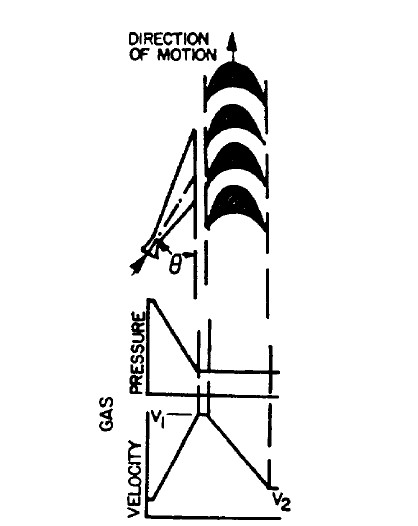 Pressure and velocity diagram for a single stage, single rotor impulse [1] |
2) Velocity compounded impulse turbine
This type has 2 separate rows of rotating blades. One set of stationary blades is located between the two rotating blades. Ideally, the entire pressure drop is in the stationary nozzles. The velocity decreases only at the rotating wheels and remains constant at the stationary nozzles. This type is seen as 1 stage, because of 1 pressure drop. [1]
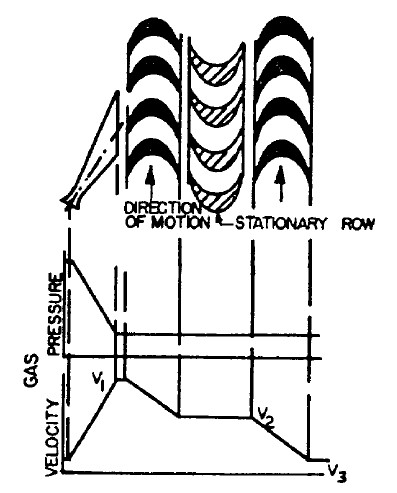 Pressure and velocity diagram for a Velocity compounded impulse [1] |
3) Pressure compounded impulse turbine
This type expands the gas in different stages throughout different rows of stationary nozzles. After a set of stationary nozzles, a set of rotating blades is placed. The pressure of the different rotating blades is different. As a consequence, bypass flows have to be prevented. As a result, sealing diagrams are applied. [1]
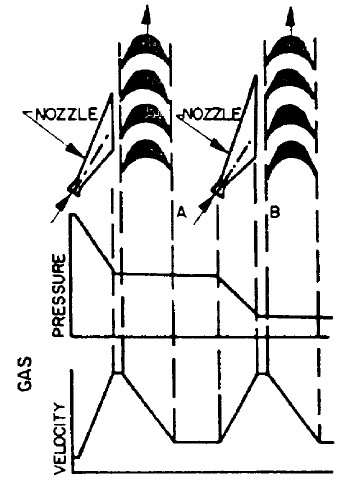 Pressure and velocity diagram for pressure compounded impulse turbine [1] |
4) Reaction turbine
The difference between an impulse turbine and a reaction turbine is that the static pressure drop occurs at the rotating blades. In theory, the driving force is derived from the gas expansion in the rotating blades. In reality, the driving force is also partially caused by the gas impingement of the blades. The percentage of the ratio of the static pressure decrease about the rotor, divided by the pressure drop between the nozzle and rotor. A percentage smaller than or equal to 50% is more efficient. [1]
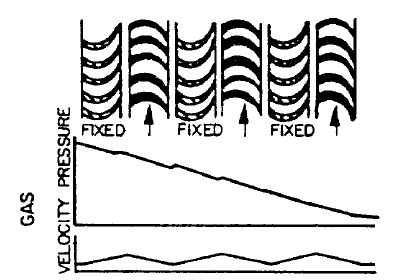 Pressure and velocity diagram for a reaction turbine [1] |
1) Bipropellant gas generator
This method was generally used to power the turbine until 1970. The great benefit of this method is the use of the main engine propellant. Hot gas is generated in the gas generator, which is fed to the turbine. After powering the turbine, the gas is dumped overboard or to a lower-pressure point. This method uses a high pressure ratio and low flow rate, so it powers an impulse-type turbine. [1]
2) Monopropellant gas generator
This method is the simplest one to power the turbine. However, the drawback is the necessity of a third propellant type. The third propellant type can be eliminated when the oxidizer or fuel can be used as a monopropellant for the gas generator. [1]
3) Thrust chamber bleed
This method is also known as the tap-off cycle. Hot gas is tapped off the main combustion chamber and fed toward the turbine. After powering the turbine, the hot gas will be dumped overboard. [1]
4) Expander
The fluid in the cooling channel will be heated in the rocket nozzle. The hot fluid is then fed into the turbine. After powering the turbine, the gas is then injected into the main combustion chamber. [1]
5) Dual (staged) combustion
The entire fuel flow and the entire oxidizer flow react in the gas generator. Often, this combustion is a fuel-rich mixture. Then it is fed into the main combustion chamber to react further. It is also possible to have an oxidizer-rich mixture that is fed into the main combustion chamber. [1]
1. Direct drive
By a direct drive method, a common shaft is used to transfer the generated power of the turbine to the pumps. The turbine can be placed in the middle of the pumps, or the turbine can be placed after the pumps. The last option is also known as back-to-back placement. Because of the common shaft, the pumps have the same rotational speed as the turbine. [1]
2. Geared drive
It is also possible to add a gearbox between the turbine and pumps. Because of the use of gears, the rotational speed of the pumps can be adjusted. The turbine can be placed between the pumps, which is known as the pancake option. This option enables different rotational speeds between the pumps and the turbine. Another option is the offset option, which means that the pumps have the same rotational speeds, but a different rotational speed compared to the turbine. It is also possible ot have a single-geared gearbox. Hereby, the turbine and 1 of the pumps have the same rotational speeds. One of the two pumps has a different rotational speed because of the option. [1]
3. Dual shaft drive
This method describes that each pump is equipped with a turbine. The hot gas, which powers the turbine, can be supplied in parallel or series ducting. [1]
See the figure below for a graphical overview:
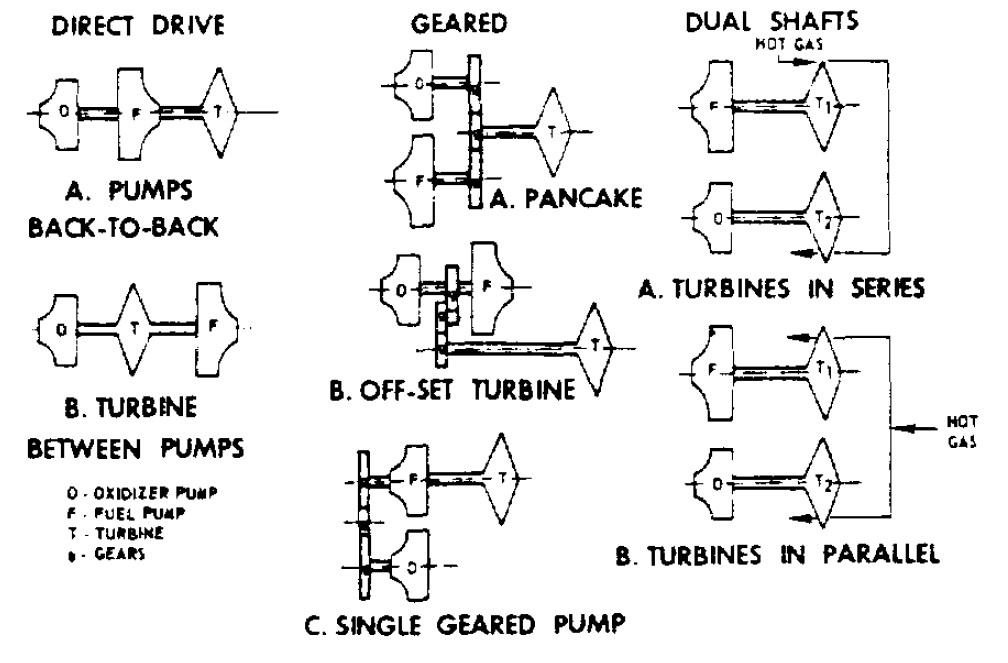 Graphical overview of the different turbine drives option [1] |
1. Pump developed head
The pump develope head describes the difference between the pump discharced head and the pump suction head. It represents the added energy to the fluid and is defined as follows:
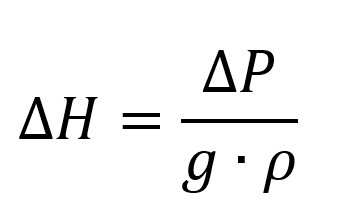 Definition of the pump head |
In this equation the following parameters are defined:
- ρ: density in kg/m3
- Δ H: developed head in m
- Δ P: pressure difference in Pa
- g: gravitional acceleration, which has a value of 9.81 m/s2
This equation assumes incompressible flow. When determining the developed head for a pump that uses liquid hydrogen, this is not really the case. Howerver, when the pressure differenct is small (<1000 psi) it can be assumed to be incompressible. The required developed pump is also a function of the hydraulic resistance, the thrust chamber pressure, volume flow and pump speed.
2. Pump head coeficient
The parameter pump head coeficient can also be defined:
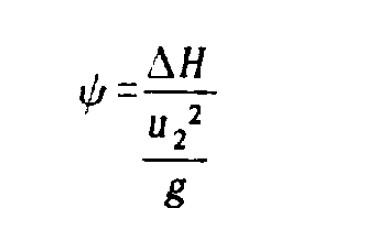 Definition of the pump head coeficient [1] |
In this equation the following parameters are defined:
- ψ: pump head coeficient [-]
- Δ H: developed head in m
- U2: meat tip velocity of the impeller in m/s
- g0: gravitional acceleration, which has a value of 9.81 m/s2
Typical values of a pump head coeficnet are as follows:
- single stage centirgual pump: 0.4 < ψ < 0.7
- axial pump: 0.2 < ψ < 0.4 [1]
3. flow coefficient
Another parameter that can be defined is the flow coefficient:
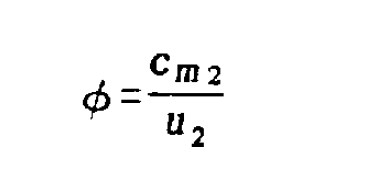 Definition of the flow coeficient [1] |
In this equation the following parameters are defined:
- φ: pump flow coeficient [-]
- cm2: average meridional velocity in m/s
- U: tip speed in m/s
Typical values of a flow coeficnet are as follows:
- Inlet: 0.07 < ψ < 0.3
- Outlet: 0.01 < ψ < 0.15 [1]
4. Pump affinity laws
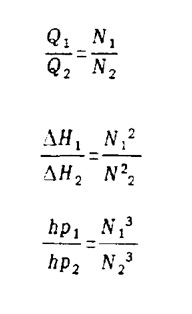
Different relations exists to determine the pump develoed head, volume flow and required pump horse power as function of the rotatonial speed. These are known as pump affinity laws and are defined as follows:
 Definition of the pump affinity laws[1] |
In this equation the following parameters are defined:
- Q;: volume flow in m3/s
- Δ H: developed head in m
- hp: required horsepower
- N: rotational speed in rpm
The pump affinity laws has the assumption that the efficienty remains constant. Howerver, this is not entirely true and differes roughly 2% - 3%. [1]
5. Pump specific speed
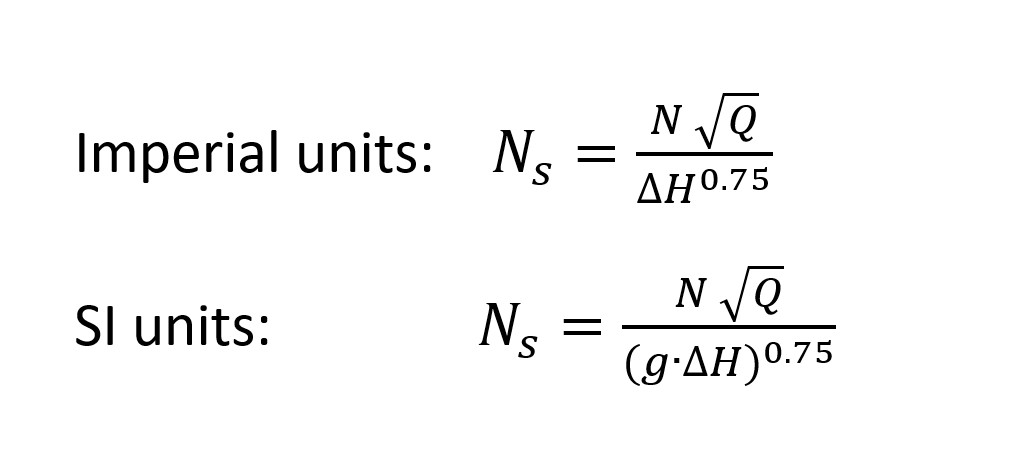
A characterstic value of the pump can be determined, this is knowns as the pump specific speed. This is defined at maximum of the pump. It gives the impression that the pump specific speed is dimensionless, however this is not true! There is a differene when using imperial or SI units and are defined below:
 Pump specific speed |
In this equation the following parameters are defined:
- Ns Pump specific speed Imperial/SI units
- Δ H: developed head in feet/meter
- Q: Volume flow in gpm/m3/s
- N: rotational speed in rpm/rad/s
- g0: gravitional acceleration, which has a value of 9.81 m/s2
The pump specific speed has the same value, independend of the size and rotational speed of a pump. Low values of a specific speed leads to low flowrate, but high developed head. A high value of the specific speed leads to high flow rates, but low developed head. [1]
The pump specific speeds are defined for different types of pumps, but be careful with the used units . A francis type impeller, which is most representilbe of a rocket engine pump, has a pump specific speed of 1000 - 2400 (imperial units). This type of a pump has a ratio of the outer radius and inducer ratio of 1.3 - 1.8.
6. Net positive suction head
When the static pressure at the inlet is lower that the vapour pressure, cavitaiton will occure. When caviation takes place, the pump will be damaged and has a negative impact on the performance. So, it is advised to prevent caviation to happen. The parameter net positive suchtion head (NPSH) can be defined in order to determine if caviation will ocure at the inlet of the pump. Herby the parameters NPSH that is available (NPSHa) is compared to NPSH cricitical (NPSHc).
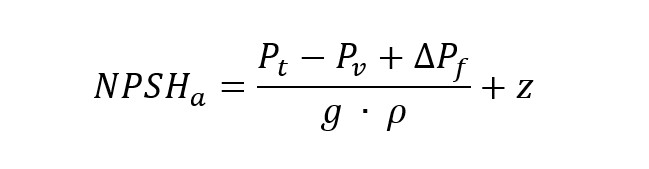
The NPSHa is defined as follows:
 Definition of NPSHa available |
In this equation the following parameters are defined:
- NPSHa: Net positive suction head avaiable in meter
- ρ: density in kg/m3
- pt: tank pressure in Pa
- pv: vapour pressure in Pa
- g: gravitional acceleration, which has a value of 9.81 m/s2
- z: height of the propellant tank in meter
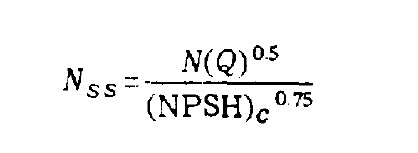
The Critical Net Possitive Suction Head (NPSHc) describe when cavitation occures. In general, the rocket pumps operate at caviation to minimize weight. Together with NPSHc and suction specific speed parameter can be defined:
 Definition of NPSHc available |
In this equation the following parameters are defined:
- NPSHc: Net positive suction head critical in meter
- N: rotational speed in rpm
- Q: Volume flow in gpm
- Nss: Suction specific speed (imperial units!)
The Nss has a value of 10000, using imperial units, for pumps without an inducer. When an inducer is included, the Nss, using imperial units, has values of 100000. [1]
The NPSHa has to be bigger than NPSHc to prevent caviation:
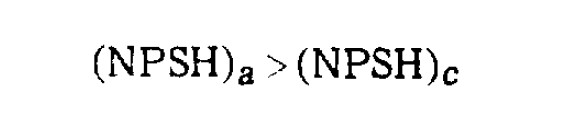 Definition of condition to prevent cavitation |
The parameter NPSHc is used to determine the rotational speed of the pump compared to the NPSHa. It is desireble ot have a hight rotational speed, because this leads to higher turbine performance. Cavitation should not only be studied for stead state operation, but also for start and shutdown scenarios.
[2]: Rocket Propulsion Elements - George P. Sutton and Oscar Biblarz